
Astera ReportMiner
Extract data from mainframe reports.
Accurately. Automatically. At scale.
Template-based extraction for fixed-width reports from IBM z/OS, AS/400, and IBM i. No OCR. No LLM guesswork. Character-position precision on every field, every page, every run.
No credit card required · Works with IBM z/OS, AS/400, IBM i Series
The problem
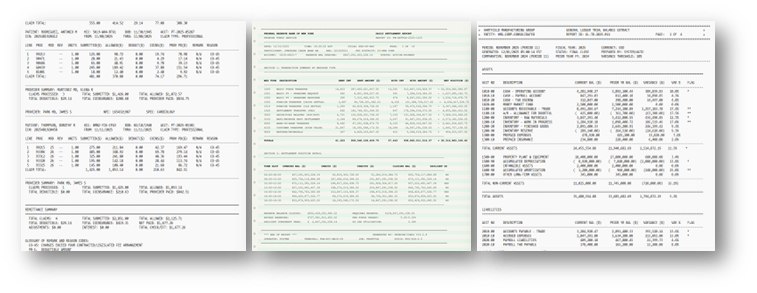
Mainframe reports look like no other document
Data lives in exact character positions: fixed-width text with no delimiters, no labels, no markup. One column off, and a $287 billion settlement amount silently becomes something else.
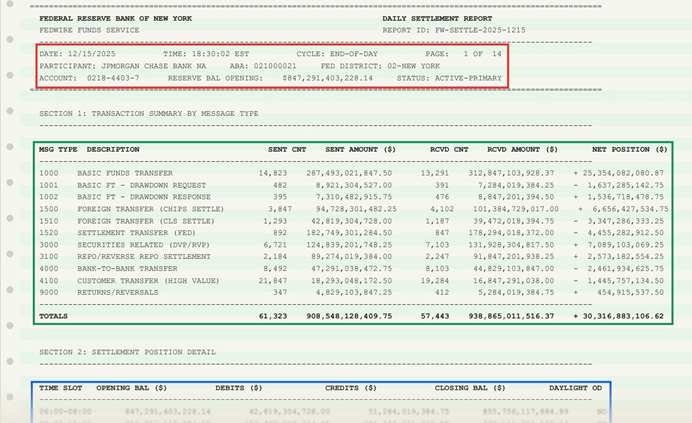
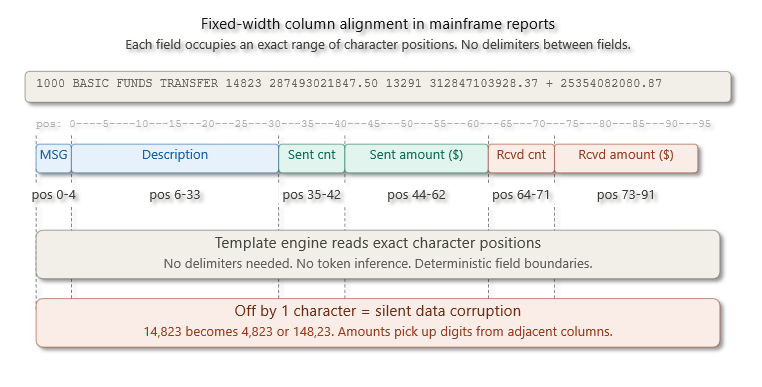
Hover over fields to see character-position extraction. LLMs process tokens, not character arrays. ReportMiner's template engine operates on positions directly.
Why Template-Based Extraction is Your Best Bet with Mainframe Reports
Tokenization, not characters
LLMs read tokens, not character positions. Without delimiters, they can't find field boundaries in dense fixed-width rows.
Context window limits
A 1,000-page report won't fit in any context window. Headers on page 1 that apply to data on page 247 are lost.
Non-deterministic output
The same report processed twice may produce different results. In financial settlement reconciliation, that's unacceptable.
Cost at scale
Per-page inference pricing makes daily batch processing of thousands of pages prohibitively expensive.
The real complexity
One file. Multiple schemas. Hierarchical data.
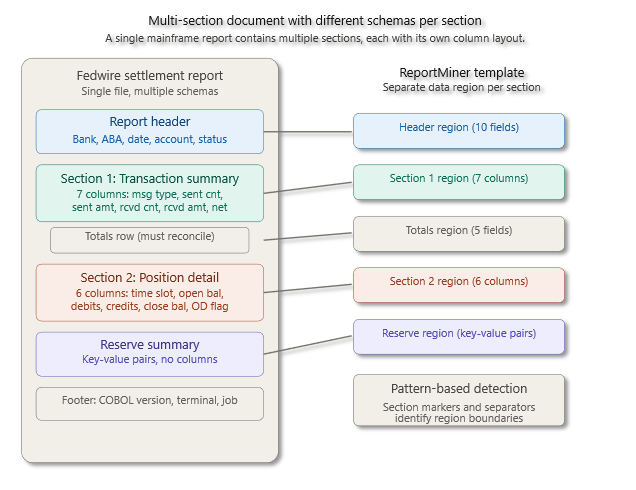
A single mainframe report often contains multiple sections with completely different column layouts. ReportMiner handles each with its own data region and field definitions.
Hierarchical output preserved
Header fields export as the parent record, with each section's rows as child collections. Output goes to nested JSON, XML, or normalized database tables with foreign keys.
How it works
From raw report to production pipeline in under an hour
The same workflow applies to any mainframe report type.
Ingest the report
Load fixed-width text files from SFTP, file drops, or batch feeds. No preprocessing, no OCR, no conversion needed.
Auto-generate the template
AI analyzes the document structure and generates a complete extraction template, with separate data regions for each section, in about 5 seconds.
Preview and verify
Hierarchical preview shows every extracted field organized by section. Adjust character positions if needed. Auto-Generate Layout typically gets it right on the first pass.
Validate and transform
Apply business rules: verify numeric fields, reconcile totals against detail rows, validate routing numbers. 300+ built-in functions handle formatting and type conversion.
Export to any destination
Write directly to SQL Server, Oracle, data warehouses, flat files, APIs, or cloud storage. 200+ native connectors, no manual export steps.
Schedule and automate
Job Scheduler triggers extraction on file arrival. The pipeline runs automatically with alert emails on validation failures and centralized monitoring.
What it looks like inside ReportMiner
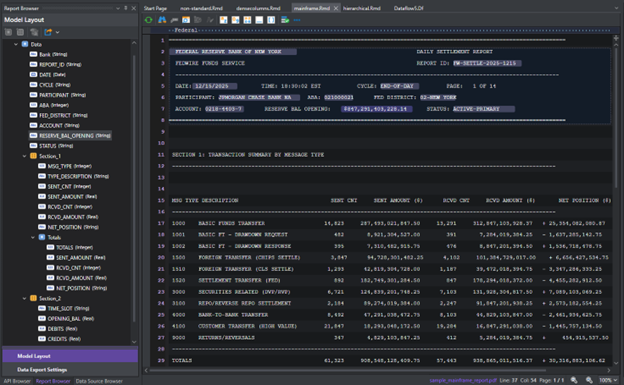
Template builder - fields are extracted and organized by section
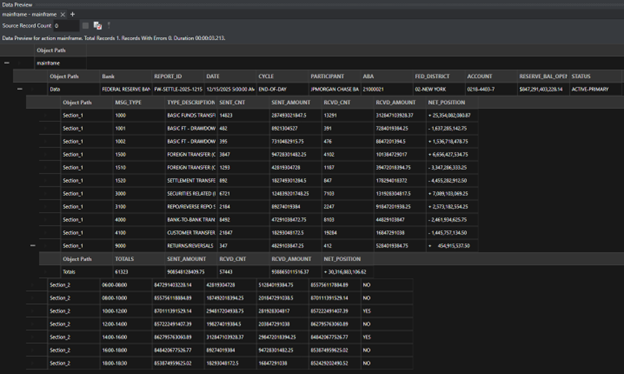
Data preview - structured output with parent-child hierarchy preserved
Initial setup takes 15–60 minutes per report type. From that point forward, it runs automatically with no manual intervention.
Key capabilities
Built for the hardest extraction problems
Multi-section extraction
Separate data regions with independent field definitions. A 7-column transaction summary and a 6-column settlement detail coexist in one template.
Hierarchical output
Parent-child relationships preserved. Export to nested JSON, XML, or normalized database tables with foreign keys.
Cross-page continuity
Templates apply as continuous text streams. A template defined on page 1 works consistently across 10,000 pages with linear scaling.
Pattern-based section detection
Section boundaries identified by markers, separator lines, and repeating header patterns, not page breaks or whitespace guesses.
At scale
Built-in transformation functions
Native export connectors
Per-page processing time
Per-page inference cost
Why templates win on mainframe reports
ReportMiner vs. LLM-based extraction
The COBOL programs generating these reports haven't changed in decades. A template defined once works forever.
| Capability | ReportMiner | LLM-based tools |
|---|---|---|
| Fixed-width column parsing | ||
| Multi-section schemas | ||
| Hierarchical parent-child output | ||
| 1,000+ page documents | ||
| Deterministic results (zero variance) | ||
| Sub-second per-page processing | ||
| No per-page inference cost | ||
| Cross-page header inheritance |
AI still plays a role: Auto-Generate Layout uses AI to create templates faster. But for steady-state processing, template-based extraction is the right method.
Industries
Trusted across regulated, high-volume sectors
Wherever mainframe reports drive critical operations, ReportMiner handles the extraction.
Financial services
Daily settlement reports, general ledger extracts, SWIFT message summaries, regulatory filings (CCAR, DFAST, FR Y-9C), nostro/vostro reconciliation reports, treasury position reports.
Insurance
Claims run reports, loss ratio summaries, actuarial data extracts, policy administration printouts, reinsurance bordereau files.
Manufacturing
Bill of materials reports, production scheduling outputs, inventory position reports, quality control batch records, MRP outputs from AS/400 and IBM i.
Government & healthcare
Medicare remittance advice reports, Medicaid eligibility files, Social Security administration outputs, VA claims processing reports, CMS regulatory submissions.
Utilities & telecom
Billing system extracts, usage summary reports, network performance outputs, regulatory compliance filings.
After setup
What ongoing operations look like
Extraction logic lives in a visual template editor, not custom code. The pipeline is monitored through a dashboard, not log files.
Initial setup
Generate templates, verify output, configure export. 15–60 minutes per report type.
Steady-state
Pipelines run on schedule or file-arrival triggers with centralized monitoring.
Ongoing involvement
Handle exceptions and onboard new report types. Routine extraction requires zero interaction.
Most teams go from first report to production pipeline in under a day.
FAQs
See it work on your report
Load your mainframe report, run Auto-Generate Layout, and check the extracted output. Most teams see accurate results on the first pass.